


Industrial app development: the backbone of modern manufacturing
In an industry characterized by precision, efficiency, and real-time control, industrial app development tailored to industrial needs is no longer a luxury—it’s a necessity. Custom industrial apps empower organizations to streamline operations, monitor equipment, track productivity, and make informed decisions based on real-time data.
The rise of Industry 4.0 and smart manufacturing has created new opportunities for organizations ready to invest in industrial app development as a key tool for digital transformation. From predictive maintenance to production analytics and workflow automation, the impact of tailored digital tools is profound.
Why Choose Custom Development for the Industrial Sector?
Off-the-shelf software can only take your operations so far. Custom apps allow manufacturers and industrial organizations to:
- Integrate with legacy systems and proprietary machinery
- Capture and analyze real-time sensor data (IoT)
- Implement tailored user workflows and access roles
- Monitor production KPIs via dashboards
- Enable predictive maintenance to reduce unplanned downtime
- Track inventory, materials, and logistics with precision
With a solid custom app, you move from reactive decision-making to proactive, insight-driven action.
Key Use Cases of Industrial Application Development
Some of the most common and high-impact industrial app development use cases include:
1. Production Monitoring Apps
Track performance metrics like output per hour, cycle times, and downtime causes. Real-time insights help line managers intervene early to prevent bottlenecks.
2. Maintenance & Asset Management
Plan maintenance based on usage data rather than fixed intervals. Integration with sensors helps detect anomalies and predict failures.
3. Logistics & Inventory Tracking
Connect RFID/barcode systems to track materials from warehouse to line-side. Improve stock accuracy and reduce shrinkage.
4. Safety Compliance & Training
Digitize safety checklists, inspection records, and training logs. Push alerts and incident reporting in real time.
5. Field Operations & Mobile Workforce Apps
Enable technicians to access machine data, record service visits, and report issues directly from mobile devices.
Best Practices in Developing Industrial Apps
Creating an industrial app that delivers tangible ROI requires a disciplined, user-centered approach:
1. Involve Operators and Technicians Early
End users offer crucial insights about day-to-day operations. Engage them in early discovery sessions to ensure the app solves real pain points.
2. Build for Harsh Environments
Design for durability. Interfaces should work in environments with low light, gloves-on usage, poor connectivity, or even dusty and noisy settings.
3. Prioritize Real-Time Performance
In mission-critical contexts, delays are unacceptable. Use lightweight UIs, edge processing, and low-latency communication protocols like MQTT.
4. Ensure Interoperability
APIs and middleware are essential for integrating with existing systems like MES, ERP, or custom PLCs. Choose frameworks with good API support.
5. Security by Design
Industrial networks are attractive targets for cyber threats. Use encrypted data transfer, role-based access control, and comply with industry standards like IEC 62443.
6. Scalability and Maintainability
Design with future needs in mind. Modular architectures allow for feature extensions, while containerized deployments (e.g., Docker + Kubernetes) ease scaling.
Native or Flutter? Choosing Based on Device Strategy and App Needs
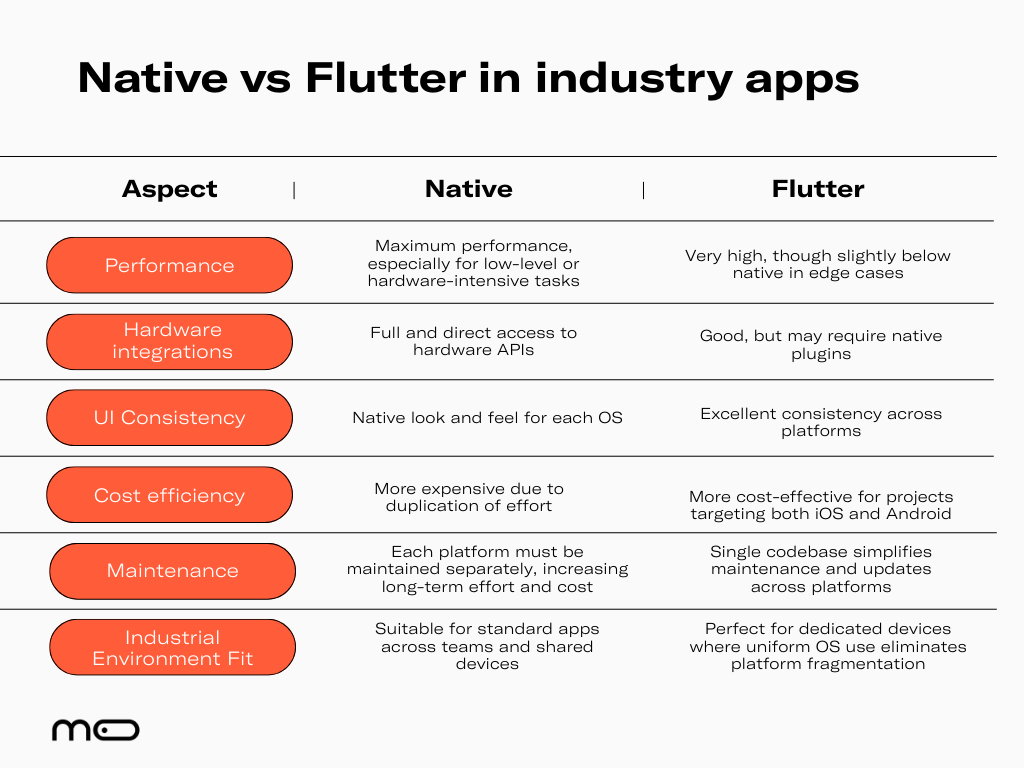
In industrial environments, it’s common for all operators or field technicians to use the same type of device—either Android or iOS—standardized across the organization. When this is the case, native app development becomes a highly attractive option. With no need to accommodate multiple platforms, native apps can deliver optimal performance, seamless integration with hardware, and a smoother user experience.
However, not every app requires deep OS-level integration. When your application doesn’t rely heavily on platform-specific features and needs to be available across both iOS and Android, Flutter is a compelling alternative. It enables faster development, shared codebases, and lower long-term maintenance costs—without compromising on performance.
Choosing between native and Flutter ultimately depends on your hardware landscape and the technical complexity of your app. Aligning your tech stack with your operational reality ensures efficiency and scalability.
Metrics That Matter
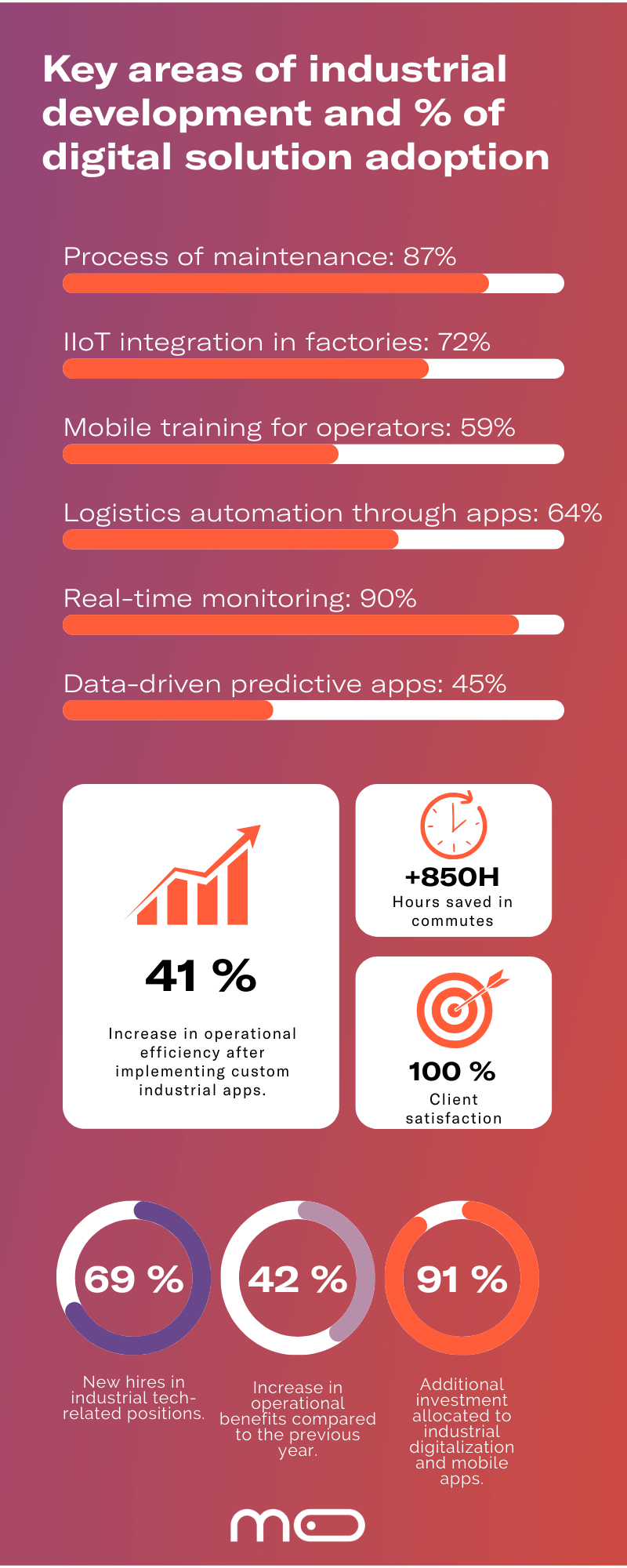
To measure the impact of your industrial application, track these KPIs:
- Downtime reduction (% decrease)
- Maintenance task completion time
- Inventory accuracy improvement
- Productivity per shift
- Mean Time Between Failures (MTBF)
- User adoption rates (operator engagement)
Success Story
At Airgrup, an aerospace company that manufactures parts for Airbus, time is gold. Their per-minute revenue makes it crucial to meticulously track the time operators spend at each workstation. To avoid unnecessary movements, we developed three applications that connect to their ERP system and have achieved:
-
Improved tracking of operator time at machines
-
Scanning and categorization of parts
-
Real-time consultation of manufacturing order statuses
A concrete example of how integrated application development enhances visibility and performance.

The Future of Industrial Apps
With technologies like AI, AR-assisted maintenance, and 5G-enabled edge computing, the industrial application landscape will continue to evolve. Staying ahead means investing not just in the latest tools, but in a development partner who understands the complexity of industrial environments.
Ready to lead your industry with custom software? Let’s talk.