


Accessibility has firmly established itself as an essential pillar of technology, and its importance was recently highlighted at a significant event in Valencia. Iñaki Bes, a Mobivery developer, was invited to the Valencia Chamber of Commerce to discuss key aspects of this concept. In this post, we summarize and analyze the most interesting points presented to help you understand why accessibility is essential to the present and future of mobile application development.
Mobile app development: understanding the difference between accessibility and usability
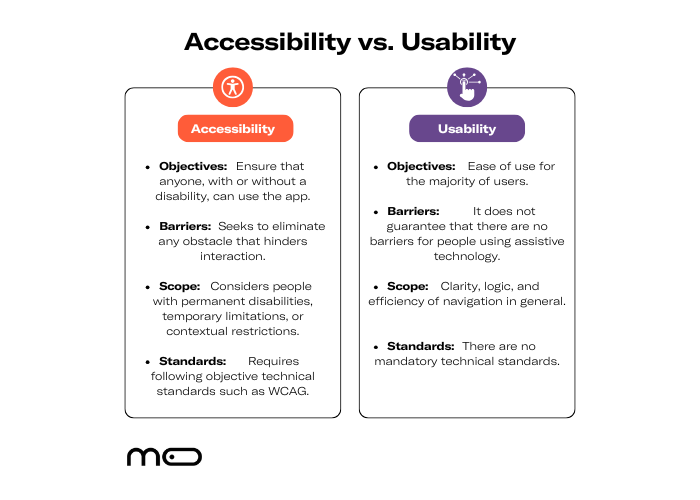
An accessible application is not simply an easy-to-use application. Accessibility means that anyone, with or without a disability, can use an application without encountering barriers that hinder their interaction. This approach considers not only people with permanent disabilities—visual, auditory, motor, or cognitive—but also those who face temporary or contextual limitations, such as an injury, a noisy environment, or a device with low visibility.
Usability, on the other hand, refers to the overall ease of use of an application: its clarity, navigation logic, and the efficiency with which it allows users to achieve their goals. Although accessibility and usability share common principles, they should not be confused. An application can be perfectly usable for most users and, at the same time, inaccessible to a person who uses assistive technology or who cannot interact accurately with a touch screen.
The development of accessible applications requires compliance with recognized technical standards, such as WCAG (Web Content Accessibility Guidelines) or EN 301 549: European Standard for Accessibility of Information and Communication Technology Products and Services. These frameworks establish objective criteria: from the correct labeling of interface elements for screen readers to color contrast, text size, and consistency in keyboard or gesture navigation. Adopting these principles not only enables compliance with regulations, but also improves the overall quality of the product.
The development of accessible applications extends beyond ensuring proper functionality
The fact that an application is operational and has active users does not guarantee that it is accessible. In practice, many people are unable to use certain digital products, not because they do not try, but because they encounter barriers that silently exclude them. The lack of complaints is not a sign of success; it is often a sign of abandonment.
In Spain, nearly five million people have a recognized disability. In Europe, that figure exceeds 80 million, and globally we are talking about more than 1.5 billion people. Added to this is a growing proportion of older people, as well as users who experience circumstantial limitations or use devices with technical restrictions.
Ignoring accessibility means leaving out a significant part of the market. Incorporating it not only responds to a social need, but also expands the user base, improves retention, and strengthens brand perception. From a product perspective, a more accessible application is, objectively, a better-designed, more robust application that is more aligned with the principles of digital inclusion.
The law requires accessibility in the development of mobile applications
Digital accessibility, in many sectors, is not an option: it is a legal obligation. In the European context, this requirement is embodied in Directive 2019/882, which came into force on June 28, 2025. This regulation stipulates that digital products and services, including mobile applications, must be accessible to all people, especially in sectors such as banking, e-commerce, transportation, telecommunications, and audiovisual content.
This obligation applies to both large corporations and small and medium-sized enterprises operating in these sectors or collaborating with public administrations. Legislation in other countries, such as the United States, is also moving in this direction, reinforcing compliance with the Americans with Disabilities Act (ADA) and requiring conformity with standards such as WCAG 2.1 at level AA.
Non-compliance can result in financial penalties, exclusion from public tenders, and loss of business opportunities. However, beyond the legal consequences, what is relevant is the ethical and strategic perspective: a product that does not take into account the diversity of users is, by definition, incomplete.
The future of accessible mobile app development
Mobile accessibility is evolving toward a new paradigm: not as an additional requirement, but as an integral part of the design and development of digital products. Android and iOS platforms already incorporate advanced features that allow the user experience to be adjusted according to each person’s abilities: smarter screen readers, voice control, text size customization, and navigation using facial gestures.
At the same time, emerging technologies such as artificial intelligence are beginning to play an important role, facilitating tasks such as the automatic generation of image descriptions or the dynamic adaptation of interfaces. In addition, the expansion of the Internet of Things means that accessibility is no longer limited to mobile devices, but encompasses the entire connected digital ecosystem.
At the same time, emerging technologies such as artificial intelligence are beginning to play an important role, facilitating tasks such as the automatic generation of image descriptions or the dynamic adaptation of interfaces. In addition, the expansion of the Internet of Things means that accessibility is no longer limited to mobile devices, but encompasses the entire connected digital ecosystem.
Because designing an accessible mobile app is not just about complying with the law: it’s about designing with a human perspective. It means understanding that technology should serve everyone, without exception, and that true digital transformation involves building truly universal products.
Conclusion: accessibility as key to app development
It is essential to understand accessibility as a core value in order to create digital products that have a significant impact. True innovation is measured not only by technological advances, but also by the ability to reach a broad audience. At Mobivery, we are committed to developing mobile applications that not only meet functional requirements but also adhere to rigorous ethical standards and are universally accessible.
Should you wish to learn more about the ideas shared by our colleague Iñaki Bes at the Valencia Chamber of Commerce, you are welcome to listen to the interview on accessibility here.
And if you are looking for advice on developing your app, you can contact our expert development team.